
Construction industry research summary. The construction industry is a vital part of the U.S. economy. However, succeeding in this sector naturally comes with many challenges, and COVID-related issues can be added to these as well. To learn more about the state of the U.S. construction market, here are some statistics about the industry:
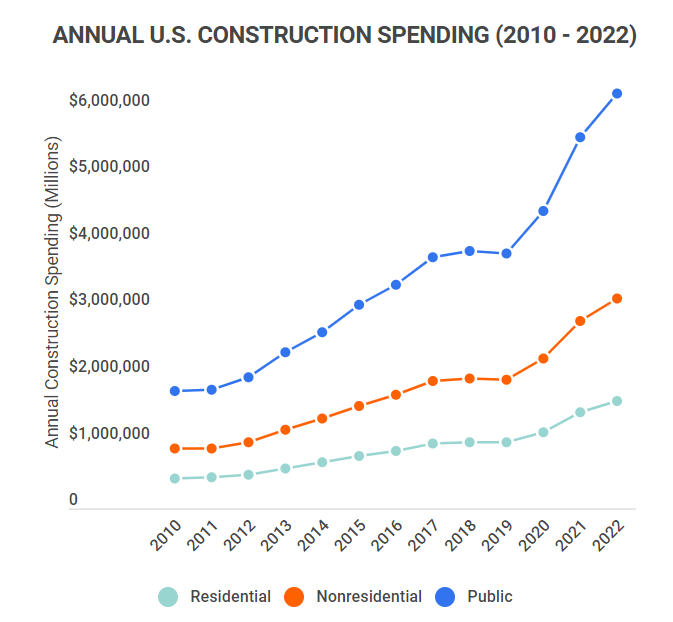
- As of January 2023, U.S. construction spending was valued at $1.823 trillion. $1.823 trilyon as of 2022.
- Approximately 7.8 million people are employed in the construction industry, which represents about %2.9of the U.S. workforce.
- The construction industry accounts for approximately %4.3of U.S. GDP.
- In January 2023, 1,406,000 new housing units were completed, representing a 12.8% increase compared to January 2022.
- The U.S. construction industry’s market size was valued at approximately $2.8 trillion as of 2022.
- Construction industry revenues increased annually by %2.7 from 2016 to 2021.
- The annual average turnover rate in the construction industry was %65as of 2021.
General construction industry statistics
The construction industry is the foundation of all infrastructure in the United States. To learn more about the people and money behind the construction industry, here are some interesting statistics we have compiled:- There are more than 733,000 employers in the U.S. construction industry.
- In a three-year study, only 31% of construction projects were completed within 10% of their budgets.
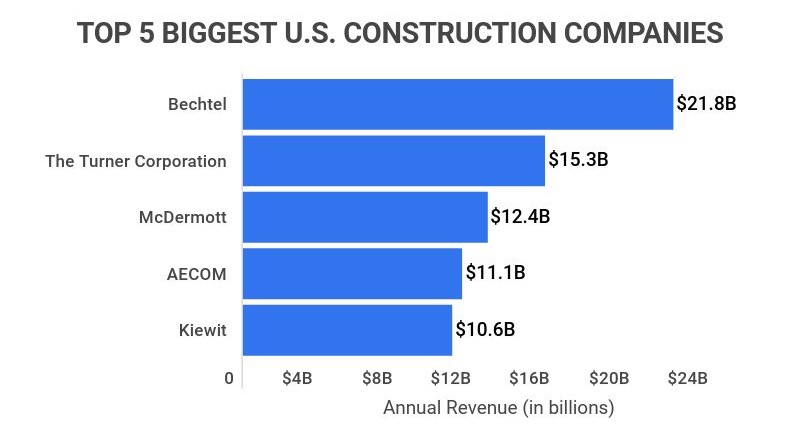
- With $21.8 billion in revenue in 2019, Bechtel is the largest construction company in the United States.
Construction industry statistics by employment
Considering the importance of the construction industry, it is not surprising that it employs a large American workforce. To highlight more interesting facts about employment in the construction industry, here are some notable statistics:-
- Construction industry workers make up approximately 2.9% of the U.S. workforce. As of January 2023, the workforce consisted of 265,962 people, and the construction industry accounted for about 7.8 million of that number. This represents an increase compared to 2009, when the industry employed about 6 million of the country’s total 143 million jobs.
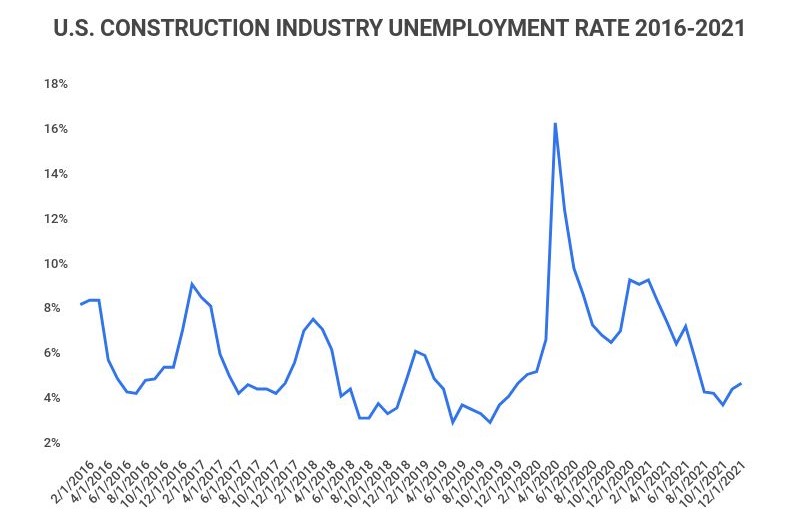
- As of January 2023, the unemployment rate in the construction industry was 6.9%. his is lower than 16.6% in April 2020. Since that dramatic peak, the industry’s unemployment rate has steadily declined, although some increases occur during the winter months. As of January 2023, the national unemployment rate was 3.4%.
-
- Women make up approximately 10.9% of all construction workers in the United States. By contrast, women make up about 57.4% of the total U.S. workforce.
- As of January 2022, construction laborers earned an average of $31.44 per hour. Construction workers are at the low end of the salary spectrum, earning an average of $20.92 per hour, while construction managers are at the high end of the spectrum, earning an average of $51.02 per hour, with an annual income of $106,120. Carpenters, electricians, operating engineers, and other construction equipment operators fall somewhere in between, earning an average of $26 to $30 per hour.
Average salaries for construction workers
| Job | Median (Hourly) | Average (Hourly) | Median (Yearly) | Average (Yearly) |
|---|---|---|---|---|
| Carpenters | $23.91 | $26.19 | $49,730 | $54,470 |
| Construction laborers | $18.38 | $20.92 | $38,220 | $43,520 |
| Construction managers | $46.09 | $51.02 | $95,870 | $106,120 |
| Electricians | $26.62 | $29.23 | $55,360 | $60,800 |
| Operating engineers and other construction equipment operators | $25.04 | $28.11 | $52,090 | $58,470 |
 English
  Turkish