

20 Trending Statistics for the US Media and Entertainment Industry in 2023: The Largest

Media and entertainment industry research summary. The Media and Entertainment industry is a well-known and growing part of the U.S. economy. As a result, Hollywood is the center of the entertainment world. Here are some notable statistics about the U.S. media and entertainment industry:

  • $1.8 trillion 1.8 trilyon dolar to the U.S. economy (7.76%).
  • ABD Medya ve Eğlence sektörü, toplam ABD GSYİH’sının %6.9‘unu oluşturur.
  • In 2022, the U.S. Media and Entertainment industry employed 1.4 million Americans.
  • The market size of the U.S. Media and Entertainment industry is $717 billion.
  • The U.S. Media and Entertainment industry is expected to grow at a %8.9 CAGR through 2030.
  • As of 2021, the global Media and Entertainment market was worth $2.2 trillion..

For further analysis, we broke the data down as follows:
Industry | Trends and Projections | Services

General Media and Entertainment Industry Statistics

Despite the decline it experienced in 2020, the Media and Entertainment industry still contributes enormous value to the U.S. economy. Here is some general information about the importance of the industry:
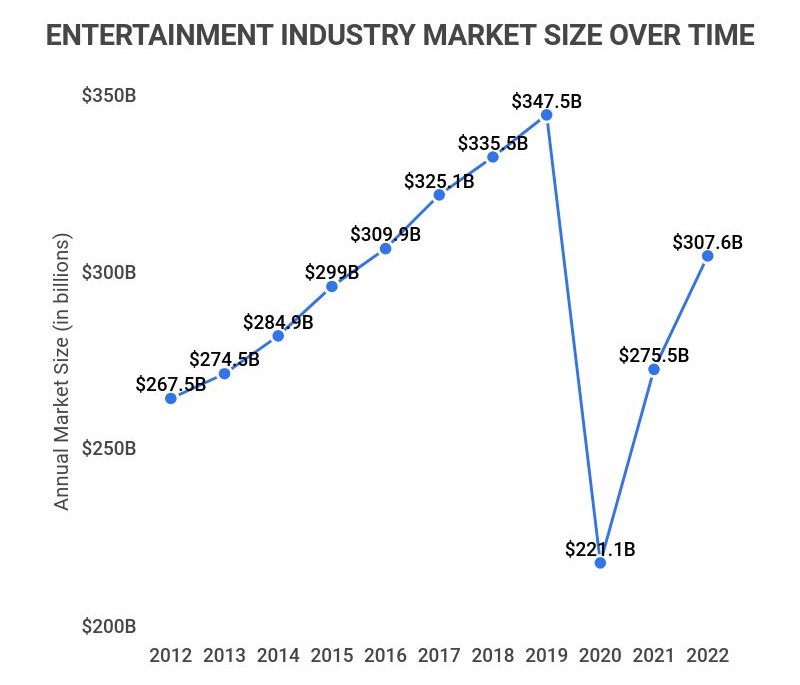
  • The U.S. Arts, Entertainment, and Recreation industry currently has a market size of $307.6 billion. Although the market experienced a 36.4% decline between 2019 and 2020, the U.S. Arts, Entertainment, and Recreation industry is moving toward recovery. The current size is still well below the $347.5 billion level reached in 2019, but far above the 2020 low of $221.1 billion.
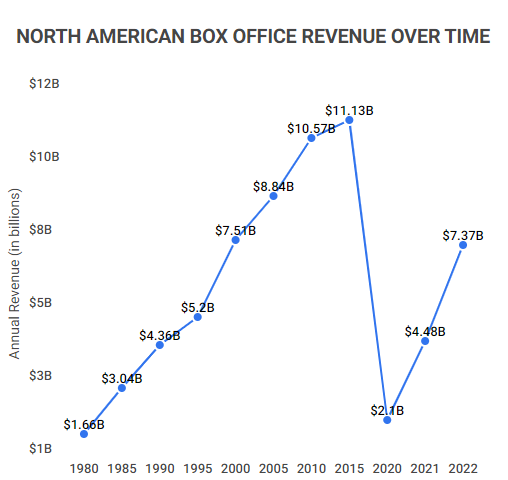
  • Box office revenues fell 81.4% between 2019 and 2020. In 2019, North American box office revenues reached $11.32 billion. Although there had already been a slight decline from 2019, it cannot compare to the historic drop seen in 2020. Due to the COVID-19 pandemic, box office revenues fell to just $2.1 billion. Total North American box office revenues reached approximately $7.37 billion in 2022, an increase from $4.48 billion in 2021. Zaman İçinde Kuzey Amerika Gişe Gelirleri
  • The United States creates one-third of the global entertainment and media market. Due in part to Hollywood’s popularity and global influence, U.S. films, television programs, broadcast content, music, radio, book publishing, video games, and more have a major cultural impact across the world. Video games, and more have a major cultural impact across the world.
  • Since 2016, the contribution of the U.S. Media and Entertainment industry to GDP has increased by 5–7% annually. More specifically, growth was regularly around 5.5% before 2020, dropped to 1% in 2020, and by 2021 the sector’s contribution had begun to recover, reaching 7.4%.

Media and Entertainment Industry by Sector

The media and entertainment industries are very broad, whether you are a music fan, a movie enthusiast, or anything in between. With that in mind, here is some information about different sectors within the Media and Entertainment industry:
  • As of 2022, the U.S. music industry has a market size of $43 billion. Calculating the size of the music industry can be difficult because of the many related sub-industries. For example, some of the most valuable segments of the music industry include the recorded music industry ($8.8 billion), the live performance industry ($9.5 billion), and the publishing industry ($1.8 billion).
  • As of 2022, the U.S. film industry is worth $91.83 billion. Film entertainment revenues total $25.9 billion. While this may seem large, it is actually a 27% decline compared with 2019, when revenues were $35.3 billion. Still, the film industry continued to grow during the pandemic despite movie theater closures. The industry is expected to have a 4.1% compound annual growth rate (CAGR) from 2018 to 2025.
  • Five major American studios control more than 60% of total film industry revenue. Bunlar arasında: Disney (%18,2), NBCUniversal (%16,4), Time Warner (%16,2) ve 21st Century Fox (%12,9) bulunmaktadır. Hepsi birlikte toplam film endüstrisi gelirinin yaklaşık %63,7’sini oluşturur.
  • During the pandemic, Hollywood contributed $504 billion to U.S. GDP. These include Disney (18.2%), NBCUniversal (16.4%), Time Warner (16.2%), and 21st Century Fox (12.9%). Together, they account for approximately 63.7% of total film industry revenue.
  • By 2020, the gaming industry had grown 19 times compared with 2006. In 2006, the gaming industry was worth around $8 billion, but that figure has now reached $160 billion. Much of this increase may be attributed to the boom in mobile gaming, which makes up about 45% of the industry’s total value.
  • The U.S. TV broadcasting industry has a market size of $63.2 billion. However, compared with other sectors, the industry has grown relatively slowly. For example, the market size is expected to grow by only 0.6% in 2022.
  • The U.S. book publishing industry has a market size of $26.8 billion. While it is not the smallest sector, it is one of the fastest-shrinking. In fact, with a growth rate of -3% through 2022, büyüme oranı it is one of the only entertainment and media sectors projected to show negative growth.
Although the Media and Entertainment industry has not fully recovered from the COVID-19 pandemic, it has rebounded significantly. In addition, this growth is expected to remain strong in the coming years. According to research:
  • Between 2012 and 2022, the U.S. Media and Entertainment industry’s market size grew by 15%. Of course, this includes the 2020 downturn, which significantly reduced total growth. For example, the industry grew 30% between 2012 and 2019 (from $267.5 billion to $347.5 billion). However, between 2019 and 2020, the market size declined by 36.4%, reducing the overall growth rate.
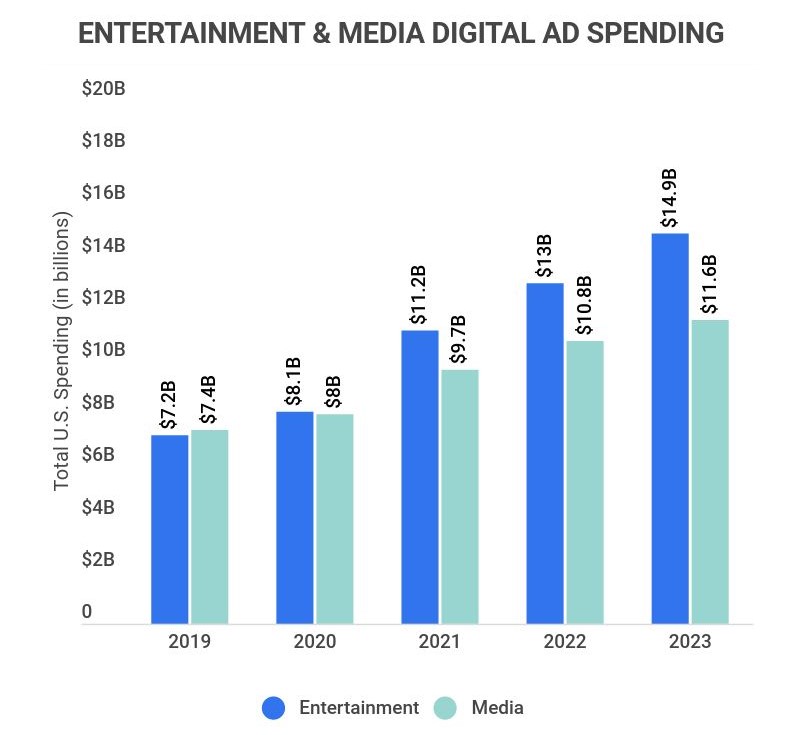
  • Between 2019 and 2023, U.S. Media and Entertainment digital ad spending is expected to increase by 81%. Digital ad spending has become increasingly popular within the industry. In 2019, digital ad spending for the media and entertainment industry was $14.6 billion, but by 2023 that figure is expected to reach $26.5 billion.
  • The U.S. Media and Entertainment industry is expected to be worth $825 billion by 2023. The industry is currently worth $717 billion, which reflects a 15% year-over-year increase in value. This shows that the industry continues to recover from the effects of the pandemic.
  • The global Media and Entertainment industry is expected to reach $2.6 trillion by 2025. The industry is currently valued at $2.2 trillion, which represents an 18.2% increase over the next few years. All things considered, the U.S. is expected to remain the industry leader through 2025.

Media and Entertainment Industry by Streaming Services

New technologies are constantly reshaping old industries, and the Media and Entertainment industry is no exception. In just the last decade, the streaming services s industry has exploded. Here are the facts:
  • OTT annual video revenue is projected to reach $316.1 billion in 2023. And with no signs of slowing, annual revenue is expected to reach $427.8 billion in 2026 and $462.9 billion in 2027.
  • As of 2022, 55.1% of Americans have canceled their cable subscriptions. For the first time, a majority of Americans have abandoned cable. This trend has accelerated since 2021, when 27% of households decided to cut the cord.
  • Video streaming accounts for 82% of internet video traffic as of 2022. Today, online video services such as Netflix, YouTube, and Hulu dominate internet usage. Four out of five internet users watch video.
  • The average American watches content on four streaming services. In general, Americans use multiple streaming services at the same time. In fact, the average U.S. household spends $47 per month on streaming subscriptions, while the average cost of one service is only $8.50 per month.
  • 77% of Gen Z spends more time watching streaming services than on other platforms. In general, the likelihood of watching streaming services decreases as demographics age. For example, 74% of Millennials watch streaming services the most, compared with 66% of Gen X and only 40% of Baby Boomers.

Media and Entertainment Industry Statistics FAQ

  1. How big is the U.S. Media and Entertainment industry? The U.S. Media and Entertainment industry is very large. Overall, its market size is $717 billion, and its GDP is larger than that of 162 countries worldwide. For this reason, the industry is very broad, comprehensive, and a major employer, with 1.4 million employees.
  2. What is the largest sector in the U.S. Media and Entertainment industry? Streaming services are by far the largest sector in the U.S. Media and Entertainment industry. In total, annual video revenue is projected to reach $316.1 billion in 2023 and $462.9 billion by 2027. In comparison, other major sectors include Music ($43 billion), Film ($91.83 billion), Gaming ($160 billion), TV Broadcasting ($63.2 billion), and Book Publishing ($26.8 billion). Four of these sectors combined would need to equal the size of streaming.
  3. What is the growth rate of the U.S. Media and Entertainment industry? The U.S. Media and Entertainment industry is projected to have a steady CAGR of 8.9% through 2030. In other words, the market size of the U.S. Media and Entertainment industry grew 15% between 2012 and 2022, including the 2020 decline. However, not every sector grows equally. Some sectors, such as gaming and streaming, are expanding quickly, while others, like TV broadcasting, are growing slowly. In addition, the book publishing sector has generally shown negative growth, making it an exception.
  1. How much of the U.S. economy is made up of the Media and Entertainment industry? Approximately 6.9% of U.S. GDP comes from the Media and Entertainment industry. This share appears to be increasing, since the industry’s contribution to GDP has grown between 5% and 7% annually since 2016. More specifically, growth was around 5.5% before 2020, dropped to 1% in 2020, and by 2021, the industry’s contribution had started to recover, reaching 7.4%.
  2. Who is the largest company in the Media and Entertainment industry? The largest company in the Media and Entertainment industry is Comcast, with $105.6 billion in revenue and $11.5 billion in net income. Comcast is a massive Media and Entertainment company that includes AT&T Broadband, NBCUniversal, Sky, DreamWorks Animation, and XUMO. Aside from Comcast, other leading companies by revenue include The Walt Disney Co. ($69.7 billion), Charter Communications Inc. ($46.6 billion), ViacomCBS Inc. ($32.8 billion), and Netflix Inc. ($22.6 billion).
  3. How competitive is the Media and Entertainment industry? The Media and Entertainment industry is highly competitive. Despite the many sectors within the industry, each faces similarly difficult competition. The reason for this is that the nature of jobs in this industry differs from many other types of work. For example, if a person studies to become a doctor or lawyer, they will most likely enter one of those professions. There will always be demand for doctors and lawyers, and their education strongly supports their skills. Similarly, if someone wants to become an electrician, they only need training for that job. However, creative training for the entertainment industry is nearly impossible without natural skill, whether for actors, musicians, or writers. Therefore, demand in the entertainment industry depends on public taste and social preferences rather than essential societal needs. In that sense, reaching the top in one of these fields can be very difficult, but also highly rewarding.

Conclusion

It is impossible to underestimate how large the Media and Entertainment industry is, with a market size of $717 billion and making up 6.9% of U.S. GDP. As a result, we interact every day with streaming services, TV, games, music, books, and other essential elements of the industry. Overall, after taking a major revenue and market-size hit in 2020, the U.S. Media and Entertainment industry has continued to grow. In addition, based on the projected 8.9% CAGR through 2030, we can expect the industry to reach the high hundreds of billions of dollars or even exceed one trillion dollars by the end of the decade.

Sources:

  1. BLS. “BLS. “Occupational Employment and Wages, May 2020.”Accessed March 30, 2022.
  2. SelectUSA. “Media and Entertainment Spotlight.Accessed March 30, 2022.
  3. Statista. “Value of the global entertainment and media market from 2011 to 2025.Accessed March 30, 2022.
  4. IW. “Arts, Entertainment and Recreation in the U.S. – Market Size 2002–2027Accessed March 30, 2022.
  5. Statista. “Box office revenue in the U.S. and Canada from 1980 to 2021.Accessed March 30, 2022.
  6. Pepperdine. “MEDIA Report: Media & Entertainment Data in America from 2016 to 2022.Accessed March 30, 2022.
  7. Statista. “Recorded music industry revenues in the U.S. from 2009 to 2020.Accessed March 30, 2022.
  8. Grand View Analysis. “Film and Entertainment MarketAccessed March 30, 2021
  9. Raise Your Skillz. “Gaming Industry vs. Other Entertainment Industries (2021).Accessed March 30, 2021
  10. IW. “Television Broadcasting in the U.S. – Market Size 2005–2027.Accessed March 30, 2022.
  11. Soundcharts. “Music Market in General Terms: Size of the U.S. Music Industry.Accessed March 30, 2022.
  12. eMarketer. “U.S. Media and Entertainment Digital Ad Spending Forecast 2021.Accessed March 30, 2022.
  13. PRN. “Music Market in General Terms: Size of the U.S. Music Industry.Accessed March 30, 2022.
  14. Statista. “OTT Video.Accessed March 30, 2022.
  15. Forbes. “Cord Cutting Is Accelerating in 2021, 27% of Cable Households Are Cutting the Cord.Accessed March 30, 2022.
  16. Insider. “Video will make up the majority of internet traffic by 2021.Accessed March 30, 2022.
  17. Vindicia. “How many streaming video services does the average person subscribe to?Accessed March 30, 2022.
  18. eMarketer. “U.S. adults by age group subscribing to streaming services or cable TV.Accessed March 30, 2022.
  19. The Hollywood Reporter. “Hollywood and the Creative Industries Added $504 Billion to U.S. GDP.Accessed March 30, 2022.
  20. Statista. “Box office revenue in the U.S. and Canada from 1980 to 2022. 13 Mart 2023 tarihinde erişildi.
  21. Statista. “OTT Video." Accessed March 13, 2023.
  22. IIPA. “Copyright Industries in the U.S. Economy 2022 Report." Accessed March 13, 2023.