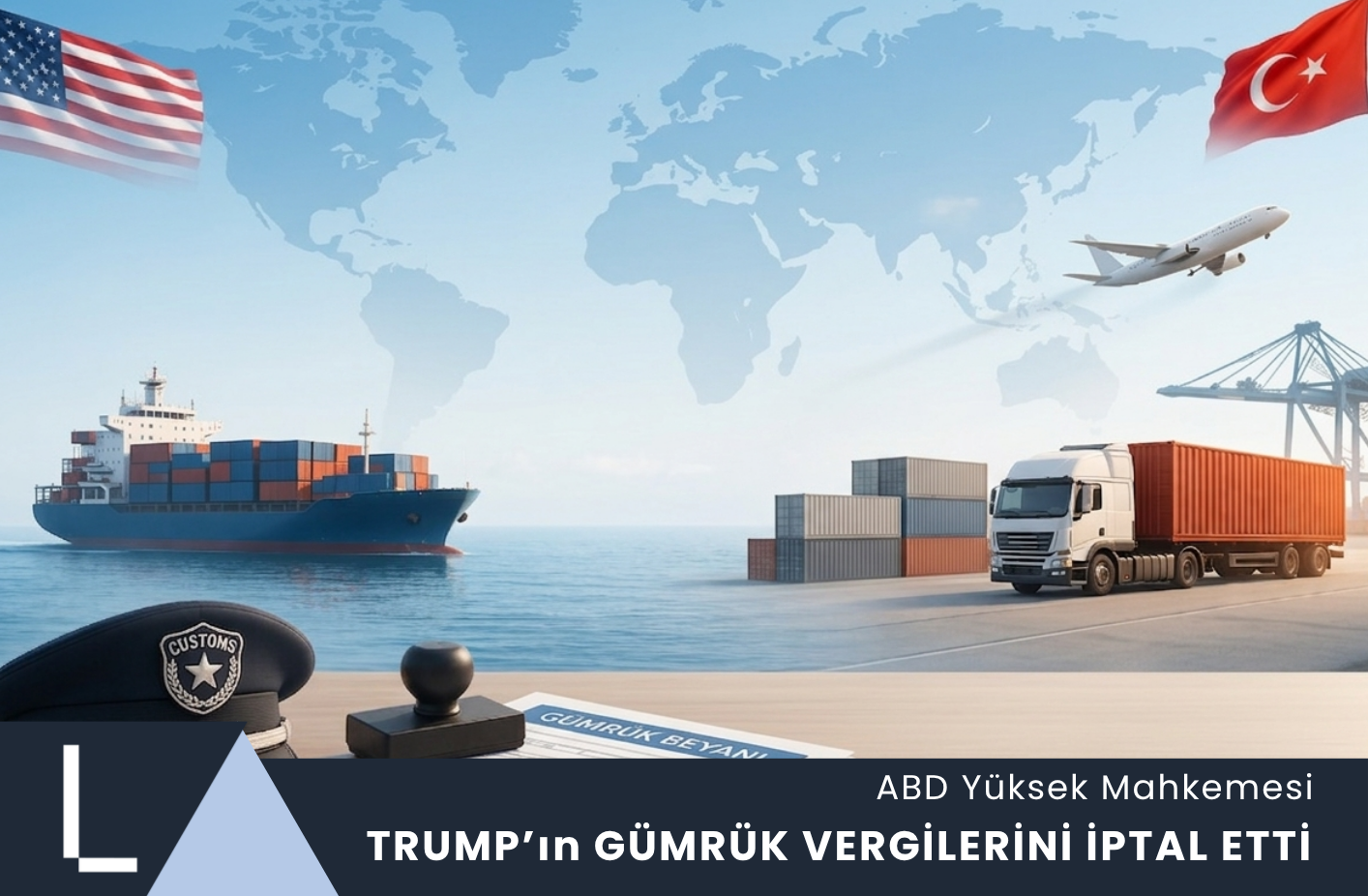
The U.S. Supreme Court’s annulment of the global tariffs implemented during the Trump era under the justification of a national emergency should not be seen merely as a political or legal development. This ruling carries an important turning point for a wide range of stakeholders, from companies engaged in foreign trade to importers, exporters, and professionals managing logistics and customs processes. Because customs duties are not merely costs paid at the border; they are critical instruments that directly affect many aspects of trade, from pricing to order decisions, from supply planning to market strategies.
In recent years, one of the biggest problems in global trade has been uncertainty. Especially in a large market like the U.S., sudden tariff decisions have affected not only American companies, but all parties selling to or buying from this market. This Supreme Court ruling is important for that reason as well. Because this development once again brings the limits of taxation authority into question and highlights how decisive legal basis and predictability are in foreign trade.
What Does the Court’s Ruling Mean?
A clear boundary has been drawn in the debate over authority!
At the core of the ruling lies the question of how broadly a president can impose customs duties by using national emergency powers. The Court made clear that this authority cannot be interpreted without limits. This approach effectively places a direct boundary on the executive branch’s power in the field of trade policy.
This is highly significant from a customs perspective. Because decisions that directly create costs, such as tariffs, are not merely tools used to send political messages. They also shape the market, alter corporate behavior, and influence the direction of international trade. In such an area, the absence of clearly defined authority creates a problem of trust in the market.
Why is this ruling not just legal news?
A court ruling often appears to be a technical matter discussed only within legal circles. But when the issue is customs tariffs, the impact is much broader. Every decision made at the border affects the rest of the chain. If an importer’s cost rises, that increase is often reflected all the way to the distributor, wholesaler, manufacturer, and final buyer.
Likewise, the removal or reduction of the tax burden can create new price balances in the market. That is why it would be incomplete to see this ruling merely as a judicial decision made in Washington. In fact, this ruling is part of a much broader debate about how foreign trade will be managed.
Why is predictability in trade so important?
In foreign trade, companies do not only sell or buy products; they also manage risk. Customs duties are one of the most visible components of that risk. The cost of a product is often shaped not only by production expenses, but also by tax and logistics burdens. If this burden changes constantly, healthy planning becomes difficult.
For this reason, predictability is not a luxury in trade but a basic necessity. Companies can only set long-term prices, enter into contracts, and make investment decisions in an environment where the rules are clear. The Court’s ruling has once again made this need visible.
What Is the Importance of the Ruling from a Customs Perspective?
Tariffs are one of the most critical parts of total cost
Tariffs are often discussed only under the heading of “additional tax.” However, in real life the situation is much broader. Among the factors determining the total import cost of a product are freight, insurance, storage, inland transportation, distribution expenses, and customs duties, all evaluated together. A change in just one of these factors can affect the product’s competitiveness in the market.
Especially in high-volume trade, even small percentage changes can create major differences in total cost. Therefore, customs duties are not merely an accounting item; they are also a tool for market entry and market retention. This is precisely why the Court’s ruling is being closely watched in trade circles.
Declaration processes and cost calculations may be reviewed again
After such a ruling, it is not enough for companies to focus only on the headlines. What truly matters is reassessing past transactions and current cost tables. Costs previously calculated based on the assumption of high taxes may yield different results under the new framework.
This may require many areas to be reconsidered, from customs declarations to quotation preparation processes. For some companies this may create an advantage, while for others it may mean a new compliance process. In particular, the issue of how additional costs incurred in the past will be evaluated may come to the forefront more in the coming period.
Legal soundness in customs creates commercial confidence
What matters is not only the existence of a tax, but also the legal basis on which it rests. For parties engaged in trade, trust arises where the rules are clear and defensible. Decisions with disputed legal foundations keep alive the question in the market: “What will the next step be?”
This, in turn, slows down decision-making processes. Yet speed is crucial in foreign trade. As uncertainty lengthens, orders may be postponed, new negotiations may slow down, and parties may behave more cautiously. For this reason, the Court’s ruling is not merely an annulment; it is also a strengthening of the demand for legal clarity.
Possible Effects of the Ruling on Foreign Trade
Pricing balances may change
Tariff decisions are first reflected in prices. If there is an additional tax, the product becomes more expensive; if tax pressure decreases, the market price balance may be reestablished. However, this change should not be expected to occur immediately or equally. Because in the market, prices are not determined by tax alone; stock costs, freight levels, exchange rate effects, and contract terms also play important roles.
Still, one of the most visible effects of this ruling will be that cost calculations are put back on the table. Companies may now have to work with different scenarios when preparing new quotations.
Order behavior may be affected
In periods of high uncertainty, buyers generally show one of two tendencies: either they move orders forward or they prefer to wait completely. Tariff decisions are exactly the kind of issues that influence such behavior. After the Court’s ruling, some buyers may act cautiously to understand the new market situation, while others may become active again with the hope of more favorable costs.
For this reason, the ruling may affect not only the tax structure but also the timing of purchases. In foreign trade, the issue is often not the price itself, but when the decision will be made.
New legal and administrative steps may come onto the agenda
The significance of the ruling does not mean the debate has ended. On the contrary, such rulings often pave the way for new regulations and new policy instruments. Therefore, it may be risky for companies engaged in foreign trade to act with the mindset that “the issue is closed.”
Trade policy is a living field. When one channel closes, another may open. For this reason, companies should pay close attention not only to the current ruling but also to the regulatory steps that may follow.
What Should Be Considered in This New Period?
Product-based analysis is essential
Broad evaluations in trade do not always produce healthy results. Even products sent to the same market may face entirely different conditions depending on the product group, the applicable legislation, and the tax structure. Therefore, to understand the real effect of such a ruling, one must proceed not from general assumptions but from product-specific analysis.
It is difficult to reach a clear conclusion without explicitly analyzing which elements affect a product’s total cost, under which delivery method it is shipped, and under which commercial conditions it is priced. A sound evaluation is only possible when all these variables are considered together.
Quotation and contract language must be structured more carefully
One of the areas most affected by tariff changes is the content of trade documents. Questions such as how long a price will remain valid, how costs will be shared if taxes change, and how revisions will be made if new conditions arise now carry much greater importance.
For this reason, quotation and contract texts should be prepared in a way that is more flexible yet also clearer. In times of uncertainty, a well-prepared text can sometimes become the strongest commercial safeguard.
It is necessary to act quickly but in a measured way
In such periods, the biggest mistake is either excessive optimism or moving entirely into a waiting position. Yet in foreign trade, the right approach is often to act quickly but in a controlled manner. It is necessary to follow the market closely, prepare alternative scenarios, and take positions according to new developments.
Inaction also creates risk. Because in times of uncertainty, the greatest advantage is often the ability to read change before competitors do.
Conclusion
The real issue is bigger than Trump tariffs! daha büyük!
The U.S. Supreme Court’s ruling on Trump-era tariffs may appear on the surface to be a tax debate, but in essence it raises a much bigger issue: how strong, how clear, and how predictable are the rules in global trade? In the world of customs, success is possible not only through low cost, but also through reliable rules.
In the coming period, the impact of this ruling will be felt not only in courtrooms but also at trade tables. Many topics, such as pricing, order planning, contract management, and customs strategy, will be reassessed. Therefore, this development should be read not merely as a current news item, but as an important signal about the future of foreign trade.


 English
  Turkish